The right school in India is no longer just confined to the prospect of good marks or a large playground. Parents now look for something deeper: a clear path from the classroom to a college seat. A quiet shift has occurred where top schools form official bonds with universities.
These tie-ups change how subjects are taught and how students prepare for higher studies. This article explains why parents should choose institutions with the best school ranking in India that offer this collaboration. It focuses on how such partnerships add real value to a student’s journey from standard nine to graduation.
Direct Entry Routes Save Time and Stress
Many families worry about cut-off lists and entrance exam chaos after class twelve. A school with a university tie-up often provides a direct admission channel for eligible students. For instance, top schools in Pune linked to a private university may reserve a fixed number of seats for their own graduates. This arrangement reduces the last-minute rush to apply to dozens of colleges. Students still need to meet basic percentage criteria, but the uncertainty drops sharply.
Curriculum Gets a University Grade Upgrade
Regular school syllabi can feel far removed from what a first-year college student actually faces. University tie-ups frequently allow schools to borrow course modules from the partner college. An institution with the best school ranking in India may be affiliated with a business university, which might introduce basic accounting or entrepreneurship in class eleven. Similarly, a science stream student could attend guest lectures delivered by university professors on campus. This exposure makes the leap from school to college less of a shock. The syllabus no longer ends with textbooks; it reaches toward real academic expectations.
Faculty and Student Exchange Creates Fresh Perspectives
A tie-up often includes teacher training programs where school faculty learn from university educators. These sessions help school teachers update their own methods and subject knowledge. Meanwhile, students benefit from joint workshops, summer schools, or mentorship programs led by university students. For example, the top schools in Pune with a law university tie-up might host mock parliament sessions guided by law seniors. This interaction brings a mature academic tone to the school environment. Consequently, a class twelve student feels more confident discussing research or projects with a professor later on.
Access to University Labs and Libraries Expands Learning
Schools often struggle with limited laboratory equipment or outdated library collections. A formal tie-up can allow school students in Pune and other states to use university facilities during weekends or breaks. A student interested in biotechnology could perform advanced experiments in a university lab not available in the school. Likewise, the university library becomes a treasure of journals, past question papers, and rare reference books. This access is particularly useful for those preparing for science olympiads or history projects. Such resources turn a regular school goer into a serious learner before college even begins.
Career Guidance Gains Credibility Through University Input
School career counsellors do their best, but they sometimes lack current data on university requirements. A university partner can send their own admission officers to conduct free sessions on applications and scholarships. These officers explain exactly what a personal statement, letter of recommendation, or portfolio should contain. Tie-ups also lead to joint career fairs where twenty or more colleges set up desks inside the school. Students get to ask direct questions without travelling to different cities. Thus, the gap between school exit and college entry shrinks remarkably.
Placement and Internship Links Start Early
The most practical benefit of a school-university tie-up is a head start on professional life. Some collaborations allow students to attend university-run internship fairs while still in class twelve. A student inclined toward media could work as a school correspondent for the university’s newspaper. Others might join short certification courses in digital marketing or data analysis offered by the university. These early experiences build a resume long before the first year of college begins. When graduation arrives, that student already has a portfolio and industry contacts.
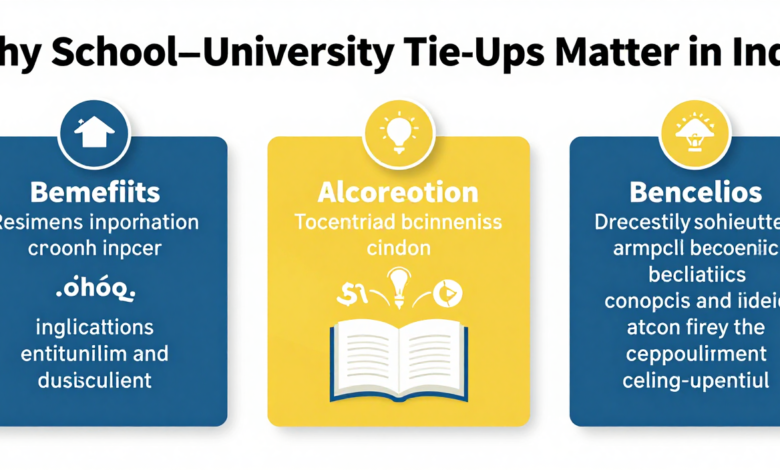
School selection in India demands attention to invisible bridges, not just visible buildings. University tie-ups create those bridges by offering admission ease, improved curriculum, teacher development, and resource sharing. Parents who ignore these partnerships may miss a chance to reduce their child’s future stress. A school with the right college connection turns ordinary school years into a launch pad. The evidence lies in fewer admission nightmares and more confident students on campus. Therefore, the next time a family visits a school, they should ask one direct question: which university does this school walk hand in hand with?